
Waking up happy in Wadi Sorhan? – A big mistake


Participating in such an expedition only further convinced me that I was right about one of my few theories about humanity. There are, in fact, only two kinds of people in this world: those who are used to waking up happy, and those who are used to waking up unhappy.
I can only imagine that if you were among the latter, having to wake up every morning in freezing temperatures and put on riding clothes permeated with the smell of camels, the physical climb we had accomplished so far would have been too much for an unhappy disposition.
It had become quite clear to me that the drivers and the support team, all volunteers who were heard making humorous noises within an hour of waking up, must all belong to the "lucky" group. Perhaps that was the reason for the team's cohesion?
Added to this was the military's recurring dark humor. The old maxim "If I don't insult you, I don't like you" was still alive and well, and every day someone became the target of one joke or another.
On the morning of stage 13, the giggling revolved around Peter W., who had just left us. The night before, Rory had jokingly (our joke) suggested removing him from the Trek WhatsApp group to see if we could provoke him. Rebecca seemed to be the only one against it. While Rory went through the process of removing him, the rest of us giggled like little schoolgirls, imagining Peter's disdain. In the morning, we wanted to know if Peter had taken the bait, and we were overjoyed to learn that he had!
It may all have been cruel, but I had learned long ago that such things boosted morale and team spirit in difficult situations. Once the mission was accomplished, possibly by upsetting Peter, he was naturally reintegrated into the group, and another member of the team became the target.
Furthermore, everyone was in good spirits that morning, because tomorrow was a rest day, and after that we would have completed half of the day's stage. Apart from the second crossing of the Hejaz Mountains four days before Aqaba, it should all be downhill from here on. We also knew that we only had two more days of riding the Saudi camels before we would switch to the Jordanian camels. We all felt that our camels had worked hard; they had been fattened up sufficiently before the trek, but were now visibly thin. They only had to push for another 100 km, or so we thought.
Leaving camp after our excellent meal at Prince Musaed's Majlis the previous evening also contributed to our sense of well-being. Rory and Ged were the lead defenders and would be proactively scouting, while Rebecca and Henry would stay nearby as our backup.
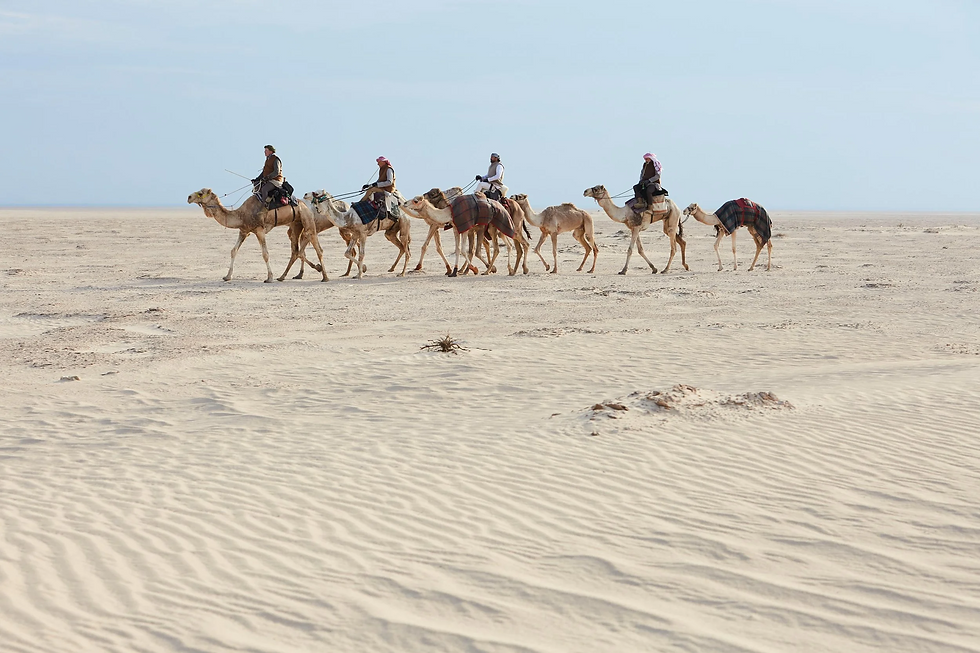
Our first route took us through soft, "baby-head" terrain, which made the camels meander between the small hills – not exactly a relaxed trot. After about half an hour, the terrain opened up to the right into a wide, flat desert with a layer of fine sand over the hard ground. It was perfect for trotting, and Rory and Ged had set off across this plain like scouts. This allowed us to reach the next camp in record time.
Around 11:00 a.m. we stopped on the flat plain, and Oliver had joined us for coffee in another Defender. While we enjoyed the ten-minute break and relieved ourselves, Captain Sa'ad from the Royal Reserve Rangers approached us in his specially equipped FJ Cruiser. "You're too far north," he said. "You need to turn left and cross the ridge."
We tried to call Rory. We could see his tracks in the desert, but his VHF radio was out of range. Oliver offered to check if he could find out anything. The track Rory had recorded and followed seemed to be correct; however, it now appeared to have led us too far north, and the ridge to the south had risen considerably.
We didn't know it at the time, but a lane had been skipped during the transfer of the route to the navigation system, and our trust in the system was about to be kicked in the ass.
At 1 p.m. it was time for a lunch break. We turned south and followed the ridge, hoping to find a way through. There was definitely no way through up ahead, and when Rory and Ged realized their mistake, they turned back from the ridge to try and find a way for us to reach them. Oliver, meanwhile, had made a U-turn in a small clearing and returned to report that there was a small track that both camels and vehicles could use. The only problem was that it was a 180-degree turn from the direction we needed to go!
We learned firsthand why Lawrence had hated this place so much. The massive volcanic boulders were scattered all over the slopes, only about half a meter apart. Impossible for camels or vehicles to get through, even if the riders had dismounted.
I made the only decision left to me: we had to take the safe route instead of searching for another one higher up the ridge. We drove back the way we came, the way that would lead us to Oliver's Pass. I knew now that every kilometer we drove added another. The drive up the pass led into the sun – exhausting and morally draining.
Finally, we came to a flat, well-trodden path, and I thought we could trot along nicely. However, it was now about 4:30 p.m., and since we had cycled 15 kilometers southeast, we had added 30 kilometers to the day's original 50 kilometers.
Around 5:30 p.m. we took a bathroom break. I asked Henry, "How far?" When he looked down at his feet, I knew from experience that this wasn't good. "You still have a long way to go. Can I leave it at that?" he asked, without looking me in the eye.
"Fifteen thousand?" I asked.
"Probably even further?", replied H.
A few curses ensued, but we all knew that talking about it wouldn't help. So we mounted and rode on as the sun set to our left. This proved to be a real test of endurance, and we could only trot downhill and walk uphill to conserve the camels' energy. Considering that, they did really well.
As is typical in the desert, it quickly grew dark, and we continued along the only path Lawrence could have possibly taken. I reflected on the fact that he and his group often had to ride through the entire night. This wasn't a problem for the camels, as they have much better night vision than humans.
We were about three kilometers from camp when we came across a farm fence. We had to make a sharp left turn, and after about a kilometer, we reached another fence that forced us back north. We took a track with a large embankment on the left. By now it was after 8 p.m., and the team had been in the saddle (shedad) for over twelve hours. We all must have been in pain, but the silence within the team told me that everyone had switched into "endurance mode"—something many former military personnel are familiar with.
We slowed down and after about 30 minutes, enclosed on both sides by fences, we saw lights ahead of us, which we assumed must be the camp; we were wrong.
It was Rory from the Royal Reserve Rangers. Once again, several farm fences blocked our way, and they explained that the only way to camp was to take a well-trodden path with camels to Highway 65, follow that road for four kilometers, and then take a different route back to camp. I reckoned it would be 12 kilometers to cover three, and riding along the roadside at night would simply be too dangerous.
I decided to leave the camels where they were, and the Bedouins could stay with them for the rest of the day. The rest of the team could remain at camp as planned, but the riders were taken to a small hotel to shower, rest, and wash their now-dirty clothes, and so it was done.
That night, after each driver had covered over 80 kilometers, they were allowed to shower and sleep in a bed for the first time in 13 days; all their clothes were also washed. The next day, the support team arrived in waves and used the same facilities for showering, while the drivers relaxed and drank coffee. The rest day was desperately needed and well-deserved. It had never been guaranteed and would have been sacrificed had we deviated from the schedule. Nevertheless, that evening we returned to the camp, which lay in the shadow of the ruins of Al Samhan Palace, where we collected the third pot of sand, which we would take with us to Lawrence's tomb upon our return to Britain.
At the end of the rest day, a fragrant group gathered around the campfire. The day's rest was a welcome refreshment for everyone. Tomorrow we would return to the camels and ride them for the last time on the final leg through Saudi Arabia. After that, only 400 kilometers, ten sleeps, and one breathtaking awakening lay ahead.



Credit: sfcbf.org


Comments